
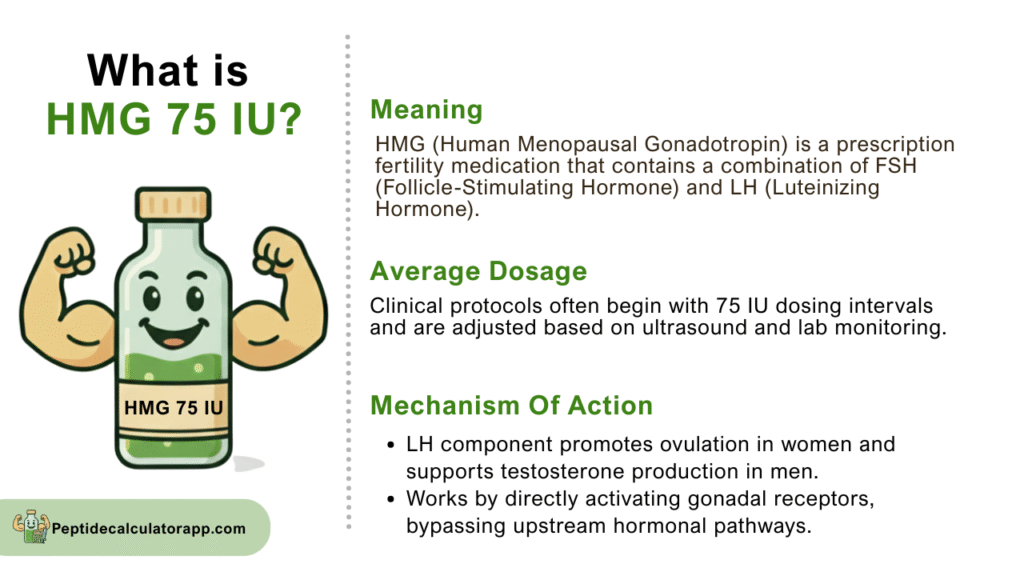
Human Menopausal Gonadotropin (HMG) 75 IU is a purified preparation containing both follicle-stimulating hormone (FSH) and luteinizing hormone (LH) in a 1:1 ratio. Originally extracted from the urine of postmenopausal women, modern HMG preparations are typically produced using recombinant DNA technology, ensuring consistent quality and reduced risk of contamination. The 75 IU designation refers to the total gonadotropin activity, with each vial containing 75 international units of combined FSH and LH activity.
This hormone preparation plays a crucial role in reproductive medicine, particularly in assisted reproductive technologies (ART) and fertility treatments. HMG 75 IU is classified as a gonadotropin and is widely used to stimulate ovarian function in women experiencing fertility challenges. The preparation’s dual hormone content makes it particularly effective in mimicking natural hormonal cycles and promoting optimal reproductive outcomes.
How HMG 75 IU Works?
The mechanism of action of HMG 75 IU involves direct stimulation of gonadal tissues through specific hormone receptor binding. FSH primarily targets granulosa cells in the ovaries, promoting follicular development and estrogen production. Simultaneously, LH acts on theca cells and later on luteal cells, stimulating androgen production and supporting corpus luteum function.
Upon administration, HMG 75 IU binds to FSH and LH receptors on target cells, activating cyclic adenosine monophosphate (cAMP) signaling pathways. This activation triggers a cascade of cellular events leading to follicular growth, maturation, and eventual ovulation when combined with appropriate trigger medications. The balanced FSH and LH content in HMG 75 IU provides comprehensive gonadotropic stimulation, often resulting in more physiological hormone profiles compared to single-hormone preparations.
The pharmacokinetics of HMG 75 IU demonstrate excellent bioavailability when administered subcutaneously or intramuscularly. Peak serum concentrations are typically achieved within 12-24 hours post-administration, with a half-life ranging from 24-36 hours. This extended duration of action allows for convenient dosing schedules while maintaining therapeutic hormone levels throughout treatment cycles.
Benefits of HMG 75 IU
Enhanced Follicular Development
HMG 75 IU provides a balanced combination of FSH and LH, which closely mimics the body’s natural hormonal signals. This dual action promotes the development of multiple mature follicles during fertility treatments, significantly improving the chances of successful ovulation and conception. This makes it especially valuable in assisted reproductive technologies such as IVF and IUI.
Higher Pregnancy Success Rates
Clinical evidence shows that HMG 75 IU can lead to higher pregnancy rates compared to treatments using agents like clomiphene citrate alone. The combination of both gonadotropins supports stronger follicular maturation and ensures a more receptive hormonal environment for embryo implantation, contributing to improved fertility outcomes in properly selected patients.
Support for the Luteal Phase
Because HMG contains LH activity in addition to FSH, it not only supports follicle growth but also enhances luteal function. Adequate luteal support is critical for preparing the endometrium, sustaining early pregnancy, and reducing the risk of implantation failure.
Improved Outcomes for Challenging Cases
HMG 75 IU has shown particular benefit in patients with poor ovarian reserve or diminished ovarian response, helping increase the number and quality of follicles produced. It is also valuable in managing PCOS patients, who may respond more predictably to the precise hormonal regulation HMG provides when used within structured treatment protocols.
Dosage and Administration
The dosage and administration of HMG 75 IU require careful consideration of individual patient factors, treatment protocols, and desired therapeutic outcomes. Standard initial dosing typically ranges from 75-150 IU daily, administered subcutaneously or intramuscularly. Treatment duration varies depending on ovarian response, with cycles typically lasting 7-14 days before ovulation triggering.
Dosage adjustments are made based on regular monitoring of serum estradiol levels and transvaginal ultrasound assessments of follicular development. Patients with poor ovarian reserve may require higher starting doses (150-225 IU daily), while those with PCOS or high ovarian reserve may benefit from lower initial doses (75-112.5 IU daily) to minimize hyperstimulation risks.
Administration technique is crucial for optimal absorption and patient comfort. Subcutaneous injection is preferred due to reduced injection site reactions and improved patient compliance. Injection sites should be rotated to prevent lipodystrophy, and proper sterile technique must be maintained throughout the treatment cycle.
Healthcare providers must establish comprehensive monitoring protocols, including baseline hormone assessments, regular follicular tracking, and careful evaluation of treatment response. Dose modifications should be implemented promptly based on individual patient responses to optimize treatment outcomes while minimizing potential complications.
Storage and Stability
Proper storage and handling of HMG 75 IU are essential for maintaining therapeutic efficacy and ensuring patient safety. Unopened vials should be stored in refrigerated conditions between 2-8°C (36-46°F), protected from light and freezing temperatures. The medication should never be frozen, as this can denature the protein structure and render it ineffective.
Once reconstituted, HMG 75 IU solutions maintain stability for up to 28 days when stored under refrigerated conditions. However, immediate use after reconstitution is recommended to ensure maximum potency. The reconstituted solution should appear clear and colorless; any discoloration, cloudiness, or particulate matter indicates degradation and necessitates disposal.
During transport and temporary storage, HMG 75 IU can remain stable at room temperature for short periods (up to 3 months), making it suitable for patient travel and clinic administration. However, prolonged exposure to elevated temperatures should be avoided to prevent protein degradation and loss of biological activity.
Patients should be educated on proper storage techniques, including the importance of maintaining cold chain integrity and recognizing signs of medication degradation. Proper disposal of expired or degraded medication is essential for environmental safety and preventing accidental exposure.
Potential Side Effects
Ovarian Hyperstimulation Syndrome (OHSS)
OHSS is the most serious potential complication associated with HMG therapy. Patients with polycystic ovary syndrome (PCOS) or a high ovarian reserve are at greater risk. Mild OHSS may present as abdominal bloating, mild pain, or nausea. Severe OHSS can involve significant ovarian enlargement, fluid accumulation in the abdomen (ascites), and electrolyte imbalances, which may require hospitalization and intensive monitoring.
Hormonal Effects
Because HMG influences FSH and LH levels, some patients may experience hormonal-related symptoms, such as mood swings or breast tenderness. These effects are typically mild and transient but should be monitored during treatment.
Long-Term Considerations
Current evidence suggests that short-term therapeutic use of HMG 75 IU carries minimal risk to bone density or cardiovascular health. However, regular monitoring and careful patient selection are essential to minimize potential adverse effects while optimizing treatment outcomes.
Monitoring and Safety Measures
Patients undergoing HMG therapy should be closely monitored via ultrasound and hormonal assays to track ovarian response and reduce the risk of complications like OHSS. Adhering to recommended dosing protocols and individualized treatment plans is critical for safe and effective outcomes.
FAQs
Q1. How long does it typically take to see results with HMG 75 IU treatment?
Ans: Most patients begin to show follicular response within 5-7 days of starting HMG 75 IU therapy. Ovulation typically occurs 24-48 hours after administration of a triggering agent, usually around day 10-14 of the treatment cycle. Complete treatment cycles, including luteal phase support, typically span 4-6 weeks.
Q2. Can HMG 75 IU be used in combination with other fertility medications?
Ans: Yes, HMG 75 IU is frequently used in combination with other fertility medications. Common combinations include GnRH antagonists or agonists for cycle control, hCG for ovulation triggering, and progesterone for luteal phase support. The specific combination depends on individual patient needs and treatment protocols.
Q3. What monitoring is required during HMG 75 IU treatment?
Ans: Comprehensive monitoring includes regular transvaginal ultrasounds to assess follicular development, serum estradiol level measurements, and clinical evaluation for signs of ovarian hyperstimulation. Monitoring typically begins 5-7 days after treatment initiation and continues until ovulation triggering.
Q4. How does HMG 75 IU compare to other fertility medications?
Ans: HMG 75 IU offers the advantage of dual hormone content (FSH and LH), providing more comprehensive gonadotropic stimulation compared to single-hormone preparations. This can result in more physiological hormone profiles and potentially improved treatment outcomes in certain patient populations.
Final Thoughts
HMG 75 IU represents a valuable therapeutic option in reproductive medicine, offering proven efficacy and established safety profiles for patients experiencing fertility challenges. The medication’s dual hormone content provides comprehensive gonadotropic stimulation, making it particularly suitable for diverse patient populations and treatment protocols.
Success with HMG 75 IU therapy depends on appropriate patient selection, individualized dosing protocols, and comprehensive monitoring throughout treatment cycles. Healthcare providers must maintain expertise in reproductive endocrinology and stay current with evolving treatment guidelines to optimize patient outcomes.
As research continues to advance our understanding of reproductive medicine, HMG 75 IU remains a cornerstone therapy that continues to help countless individuals achieve their reproductive goals. The medication’s established efficacy profile and ongoing research support its continued role in modern fertility treatment protocols.