

Degarelix is a third-generation GnRH receptor antagonist developed specifically for the treatment of advanced prostate cancer. Unlike traditional hormone therapies, degarelix works by directly blocking GnRH receptors in the pituitary gland, preventing the release of luteinizing hormone (LH) and follicle-stimulating hormone (FSH). This direct antagonism results in immediate suppression of testosterone production without the initial testosterone surge commonly seen with GnRH agonists.
The medication is administered as a subcutaneous injection and is marketed under the brand name Firmagon. It represents a significant advancement in prostate cancer treatment, offering both efficacy and improved patient outcomes compared to earlier hormone therapy options.
How Degarelix Works?
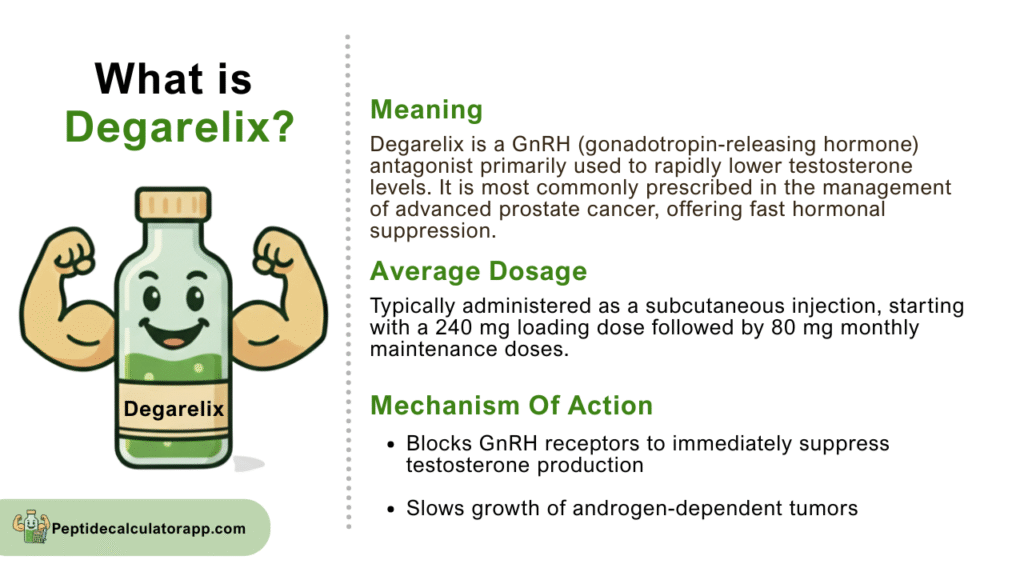
Degarelix functions through a sophisticated mechanism that directly targets the hypothalamic-pituitary-gonadal axis. The peptide binds competitively and reversibly to GnRH receptors located in the anterior pituitary gland. This binding effectively blocks the natural GnRH from activating these receptors, preventing the downstream cascade that leads to testosterone production.
When GnRH receptors are blocked, the pituitary gland cannot release LH and FSH. Without these hormones, the testes receive no signal to produce testosterone. This results in chemical castration, with testosterone levels dropping to castrate levels within 24-72 hours of the first injection. The rapid onset of action is particularly beneficial for patients with aggressive prostate cancer who need immediate hormone suppression.
The reversible nature of degarelix’s binding means that testosterone levels can recover once treatment is discontinued, making it an attractive option for patients who may need temporary hormone suppression or those concerned about long-term effects.
Benefits of Degarelix
Immediate Testosterone Suppression
Degarelix provides a major advantage over traditional GnRH agonists by avoiding the initial testosterone surge that can temporarily worsen prostate cancer symptoms. This immediate suppression helps prevent tumor flare and reduces the risk of complications such as bone pain, urinary obstruction, and spinal cord compression.
Rapid Reduction of Testosterone and PSA Levels
Clinical evidence shows that degarelix lowers both testosterone and prostate-specific antigen (PSA) levels more quickly than leuprolide. This rapid action is especially valuable for patients with advanced or metastatic disease who require urgent hormonal control to stabilize their condition.
Improved Cardiovascular Safety Profile
Research suggests that degarelix may carry a lower risk of cardiovascular events compared to GnRH agonists. Reduced rates of heart attack and stroke make it a potentially safer option for patients with pre-existing cardiovascular concerns.
Precision Therapeutic Approach
Much like the targeted benefits seen in peptide therapies such as BPC-157, degarelix highlights the effectiveness of precise hormonal modulation in modern medicine. Its targeted mechanism offers improved outcomes and greater control in prostate cancer management.
Dosage and Administration
Degarelix is administered as a subcutaneous injection following a specific dosing regimen. The treatment begins with a loading dose of 240 mg given as two separate 120 mg injections on day one. This initial higher dose ensures rapid achievement of castrate testosterone levels.
Following the loading dose, patients receive maintenance injections of 80 mg every 28 days. The injection is typically administered in the abdominal area, rotating injection sites to minimize local reactions. Healthcare providers should reconstitute the medication immediately before use, as degarelix comes as a lyophilized powder that requires reconstitution with sterile water for injection.
The injection technique requires careful attention to ensure proper drug delivery. The medication should be injected slowly over 30 seconds using a deep subcutaneous injection technique. Patients may experience some discomfort at the injection site, which is normal and typically resolves within a few days.
Storage and Stability
Proper storage of degarelix is essential to maintain its stability and effectiveness. The lyophilized powder should be stored in a refrigerator at temperatures between 2°C and 8°C (36°F to 46°F). The medication should be protected from light and kept in its original packaging until ready for use.
Once reconstituted, degarelix should be used immediately and cannot be stored for later use. If the reconstituted solution is not used within one hour, it should be discarded. The medication should never be frozen, and any vials that have been accidentally frozen should not be used.
Healthcare facilities should ensure proper cold chain management when handling degarelix to maintain its potency. Temperature excursions outside the recommended range can affect the medication’s stability and therapeutic effectiveness.
Potential Side Effects
Injection Site Reactions
The most common side effects of degarelix occur at the injection site. Patients may experience pain, redness, or swelling, affecting roughly one-third of users. These reactions are typically mild to moderate and tend to improve as treatment continues.
Hormone Suppression Effects
Because degarelix reduces testosterone levels, many systemic effects mirror those seen with other androgen deprivation therapies. Hot flashes, weight gain, decreased libido, erectile dysfunction, and fatigue are among the expected outcomes of hormone suppression and can vary in intensity from patient to patient.
Metabolic and Bone-Related Risks
More significant side effects may include decreased bone mineral density, an increased risk of developing diabetes, and changes in cardiovascular health. These risks underscore the importance of ongoing monitoring, lifestyle support, and appropriate medical follow-up during long-term therapy.
Rare but Serious Complications
Severe allergic reactions, while uncommon, can occur and require immediate medical attention. Degarelix may also cause QT interval prolongation, a heart rhythm abnormality. Patients with a history of arrhythmias or other cardiac conditions may need periodic electrocardiograms and closer clinical supervision.
FAQs
Q1. How quickly does degarelix lower testosterone levels?
Ans: Degarelix typically reduces testosterone to castrate levels within 3 days of the first injection, with some patients achieving suppression within 24 hours. This is significantly faster than GnRH agonists, which can take 2-4 weeks to achieve similar levels.
Q2. Can degarelix be used in combination with other prostate cancer treatments?
Ans: Yes, degarelix is often used in combination with other therapies such as radiation therapy, chemotherapy, or newer androgen receptor inhibitors. The combination approach depends on the stage and characteristics of the cancer.
Q3. What happens if I miss a degarelix injection?
Ans: If you miss an injection, contact your healthcare provider immediately. Delayed injections can lead to testosterone recovery, which may allow cancer progression. Your doctor will determine the best approach for resuming treatment.
Q4. Is degarelix reversible?
Ans: Yes, degarelix’s effects are reversible. Testosterone levels typically begin to recover within weeks to months after discontinuing treatment, though complete recovery may take longer in some patients.
Q5. How does degarelix compare to surgical castration?
Ans: Degarelix provides chemical castration that is equally effective as surgical castration in suppressing testosterone levels. However, unlike surgical castration, degarelix’s effects are reversible if treatment is discontinued.
Final Thoughts
Degarelix represents a significant advancement in prostate cancer treatment, offering rapid and sustained testosterone suppression without the complications of initial hormone surge. Its unique mechanism of action and favorable safety profile make it an excellent option for many patients with advanced prostate cancer.
The medication’s ability to provide immediate hormone suppression while potentially offering cardiovascular benefits sets it apart from traditional hormone therapies. As research continues to expand our understanding of degarelix’s full therapeutic potential, it remains a cornerstone of modern prostate cancer treatment.
Patients considering degarelix should discuss the benefits and risks with their healthcare team to determine if this treatment aligns with their individual needs and circumstances. With proper monitoring and support, degarelix can provide effective cancer control while maintaining quality of life.